Maths on the Move
Maths on the Move, is the podcast from plus.maths.org. We speak to researchers from the frontiers of mathematical science so you can connect with the maths that shapes and explains our world. Hosted by Plus editors Rachel Thomas and Marianne Freiberger.






Episodes
May 21, 2024
May 21, 2024
16 min
We're very excited to be going to this year's European Congress of Mathematics (ECM), which will take place in Seville, Spain, in July!
One of the interesting things that happens at an ECM is that the European Mathematical Society (EMS) awards ten prizes to mathematicians who are under the age of 35 at the start of the year the prizes are awarded. When looking through previous winners we noticed that quite a few winners of EMS prizes later go on to win a Fields Medal, one of the highest honours in mathematics, awarded every four years at the International Congress of mathematicians.
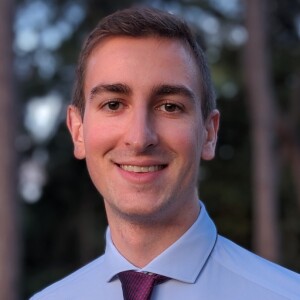
To celebrate the run-up to this year's ECM, we launch our Euromaths miniseries of podcasts, which revisits interviews with Fields Medallists from years past, who previously also won an EMS prize. We start the series by revisiting our interview with Hugo Duminil-Copin in 2022, when won a Fields Medal for his work transforming the mathematical theory of phase transitions in statistical physics. Hugo first won an EMS prize in 2016. We hope you enjoy the interview!
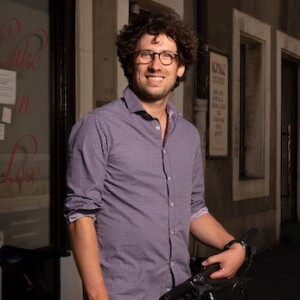
Hugo Duminil-Copin (Photo Matteo Fieni)
You can read about Hugo's work in this short introduction and this in-depth article.
This content was originally produced as part of our collaborations with the London Mathematical Society and the Isaac Newton Institute for Mathematical Sciences. You can find all our content on the 2022 International Congress of Mathematicians here.
May 15, 2024
May 15, 2024
17 min
Artificial intelligence is changing our lives. Many of us use the voice activated features on our phones to recognise, understand and fairly complex speech. Students use ChatGPT to do their homework. And doctors use AI algorithms to help diagnose many diseases from medical data. But how is AI changing the lives of mathematicians?
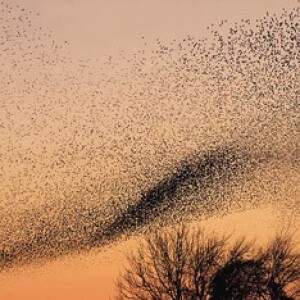
In this podcast we speak to Yang-Hui He from the London Institute of Mathematical Sciences about his recent work on the evocatively titled murmuration conjecture. This exciting new conjecture came about due to both artificial and human intelligence, and reveals patterns in the prime numbers that look like flocks of birds. (You can also read more in the article that accompanies this podcast.)
A murmuration of starlings. Photo: Walter Baxter, CC BY-SA 2.0.
We were speaking to Yang as part of our coverage of the research programme, Black holes: bridges between number theory and holographic quantum information, held at the Isaac Newton Institute for Mathematical Sciences in Cambridge. The programme brought together a fascinating array of experts in black holes and quantum theory, with mathematicians and computer scientists. You can read more in our coverage of the programme here.
This content was produced as part of our collaboration with the Isaac Newton Institute for Mathematical Sciences (INI) – you can find all the content from our collaboration here. The INI is an international research centre and our neighbour here on the University of Cambridge's maths campus. It attracts leading mathematical scientists from all over the world, and is open to all. Visit www.newton.ac.uk to find out more.

May 7, 2024
May 7, 2024
21 min
"The 20th century was the interaction of geometry and physics, and the 21st century is the interaction of number theory with physics." This intriguing insight comes from our recent discussion with Yang-Hui He from the London Institute of Mathematical Sciences. Yang told us an amazing story about the flow of ideas between mathematics and physics, that involves some of the most celebrated achievements in the last century.
Yang-Hui He (Photo Rajarshi Maiti – CC BY-SA 4.0)
You can find out more about the ideas we discussed with Yang in this podcast in the accompanying articles String theory: A promise from physics and String theory: Convincing mathematics. And stay tuned for the second part of our conversation with Yang in the next episode!
We were speaking to Yang about a research programme, Black holes: bridges between number theory and holographic quantum information, held at the Isaac Newton Institute for Mathematical Sciences in Cambridge. The programme brought together a fascinating array of experts in black holes and quantum theory, with mathematicians and computer scientists. You can read more in our coverage of the programme here.
This content was produced as part of our collaboration with the Isaac Newton Institute for Mathematical Sciences (INI) – you can find all the content from our collaboration here. The INI is an international research centre and our neighbour here on the University of Cambridge's maths campus. It attracts leading mathematical scientists from all over the world, and is open to all. Visit www.newton.ac.uk to find out more.
Apr 30, 2024
Apr 30, 2024
33 min
Mathematics is a creative pursuit so it's not surprising that there are communalities between maths and art in all its forms. In this episode we explore the intersection between maths and art with physicist Andrzej Herczyński and mathematician Paul Glendinning.
Andrzej Herczyński
Andrzej and Paul were two of the organisers of the workshop Space, scale and scaling in art, which recently took place at the Isaac Newton Institute for Mathematical Sciences in Cambridge. We find out about the rich dialogue that can ensue between artists and mathematicians, how maths and physics can help us understand the power of art and how we perceive it, and provide insights into how a particular piece of art was made.
The Space, scale and scaling in art workshop was part of a larger research programme funded by the National Science Foundation on the intersection of science and art.
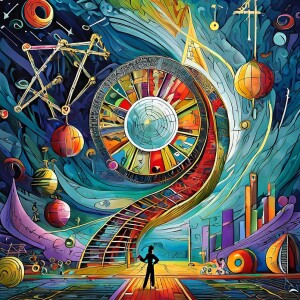
You can see Agnes Martin's painting Morning, which is mentioned in this episode, here (though the digital version does not do it justice). To see Jackson Pollock's works, which are also discussed in this episode, go to the Jackson Pollock website. The image above has been generated by AI.
Paul Glendinning
To find out more about some of the topics mentioned in this episode, see the following articles:
Fractal expressionism looks at fractal structures in works by the abstract expressionist Jackson Pollock.
The Artist's fractal fingerprint explores Pollock's paintings further.
Sine language looks at a song by our musician friend Oli Freke which explores the idea of sine waves, and how they relate to other concepts such as the Western tuning system known as equal temperament and even to ancient Greek cosmological ideas.
Fractal music has composer Dmitry Kormann explaining how he brings fractal-like patterns to the very structure of his music, with beautiful results.
Restoring profanity explores how the heat equation can help restore damaged art works.
Where to stand to look at sculptures uses some simple geometry to find the perfect vantage point from which to take in a sculpture (or painting).
To see all our content on maths and art see here, and for everything on maths and music see here.
This content was produced as part of our collaboration with the Isaac Newton Institute for Mathematical Sciences (INI) – you can find all the content from our collaboration here. The INI is an international research centre and our neighbour here on the University of Cambridge's maths campus. It attracts leading mathematical scientists from all over the world, and is open to all. Visit www.newton.ac.uk to find out more.
Apr 23, 2024
Apr 23, 2024
12 min
One of the most fascinating figures in the history of mathematics was Srinivasa Ramanujan, a self-taught Indian genius who formed a remarkable relationship with the Cambridge mathematician GH Hardy. Ramanujan was interested in problems in number theory, which are often easy to state, but incredibly difficult to prove. One amazing thing about Ramanujan's work is that it still finds applications today, in areas you'd never imagine are linked to number theory. An example is the study of black holes, those gravitational monstrosities that lie at the centres of galaxies.
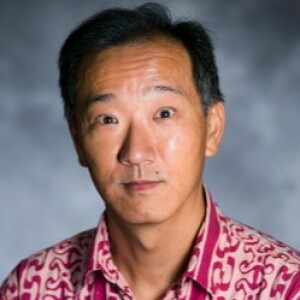
We will explore this surprising link in an upcoming episode, but for now we revisit a 2018 interview with mathematician Ken Ono (pictured above), who was an advisor and associate producer on the well-known film about Ramanujan, The man who knew infinity. Talking to Plus Editor Rachel Thomas, Ken explores just what made Ramanujan's work so special and the piece of mathematics that is relevant to black holes. Rachel talked to Ken at the Royal Society's celebration of the centenary of Ramanujan's election as a Fellow of the Royal Society.
You can also read an article accompanying this podcast, which looks at the mathematics relevant to black holes. For more about Ramanujan's mathematics, and Ken's research into it, see Ramanujan surprises again. To find out more about the Spirit of Ramanujan project, which Ken mentions in this episode, see here.

Apr 16, 2024
Apr 16, 2024
24 min
In this episode of Maths on the move we look at some favourite pieces of maths we have worked on so far this year. From a revolutionary new tile to new insights in topology, and from fooling cancer cells to bringing mathematical research into the classroom, we hope there's something interesting there for everyone.
To find out more about the topics mentioned in this episode see the following articles:
A tip of the hat: Celebrating an aperiodic monotile — meeting the discoverers of the hat
Contagious maths — bringing epidemiological research into the classroom
The mathematics of movement — what do cancer cells, birds, and whales have in common (and can a slime mould be intelligent)?
Outraged by not knowing— new insights in topology with Oscar Randal-Williams
To find out more about our work with the JUNIPER network of disease modellers see here and to find out more about our work with the maths4DL research project see here.
You can listen to the podcast using the player above, and you can listen and subscribe to our podcast through Apple Podcasts, Spotify and through most other podcast providers via podbean.
Apr 9, 2024
Apr 9, 2024
23 min
It's always exciting to have a glimpse at new mathematics and technology as they take shape. In this podcast we talk to Georg Maierhofer, from the University of Oxford, about an exciting new idea that is only just emerging – physics informed neural networks (PINNs for short) – where you add in the laws of physics to machine learning methods.
We have been able to sit in on a number of meetings of our colleagues from Maths4DL (the Mathematics for Deep Learning research group) as they explore this idea. Georg explains why PINNs are a bit like learning golf, tells us about the exciting opportunities and challenges, and why the key part to developing new ideas is getting the right people together at the right time.
You can find more about the machine learning and the some of the work that Maths4DL is doing at https://plus.maths.org/maths4dl, including our recent podcast How does AI work? and our collection Predicting the weather with artificial intelligence.
This content is part of our collaboration with the Mathematics for Deep Learning (Maths4DL) research programme, which brings together researchers from the universities of Bath and Cambridge, and University College London. Maths4DL aims to combine theory, modelling, data and computation to unlock the next generation of deep learning. You can see more content produced with Maths4DL here.
Mar 26, 2024
Mar 26, 2024
24 min
Last weekend our friends and neighbours at the Centre for Mathematical Sciences at the University of Cambridge put on a great event: the Mathematics Discovery Day, part of the Cambridge Festival. Among the may hands-on activities, games and pop-up explorations were the hugely popular, and well-attended, workshops for students delivered by our colleagues Liz and Charlie from NRICH. Our brilliant colleague Julia Hawkins herded academics and volunteers, juggled props and generally made sure that everything went smoothly.
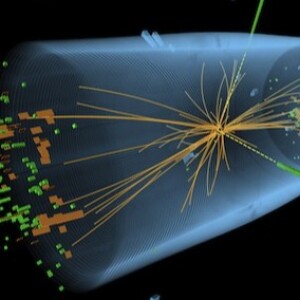
At the same time our partners at the Isaac Newton Institute next door hosted one of our favourite physicists: Ben Allanach, Professor of Theoretical Physics at the University of Cambridge. Ben gave a talk called The force awakens: Quantum collisions, in which he explored experiments at the Large Hadron Collider (LHC), particle physics, as well as recent research results which suggested there may be a fifth force of nature, hitherto unknown to science.
For those who weren't able to attend Ben's talk we revisit an interview with him from last year, in which he explains this intriguing (and if true sensational) result about a potential new force.
The image above illustrates particle collisions at the LHC and is courtesy CMS.
This content now forms part of our collaboration with the Isaac Newton Institute for Mathematical Sciences (INI). The INI is an international research centre in Cambridge which attracts leading mathematicians from all over the world. You can find all the content from the collaboration here.

Mar 19, 2024
Mar 19, 2024
26 min
Artificial intelligence has made astonishing progress in the last few years. Perhaps surprisingly, all of the amazing things we've seen, from ChatGPT to generative AI, are powered by same mathematical technique: machine learning, and in particular deep learning.
In this episode of Maths on the move we talk to Kweku Abraham, member of Maths4DL, a research project which investigates deep learning, and postdoctoral researcher at the University of Cambridge. Kweku explains how machine learning works, why it's so powerful and whether there are any limits to what it can achieve, and the kind of maths he works on every day.
To find out more about the topics discussed in this episode, see Artificial intelligence and deep learning: Your questions answered.
This content is part of our collaboration with the Mathematics for Deep Learning (Maths4DL) research programme, which brings together researchers from the universities of Bath and Cambridge, and University College London. Maths4DL aims to combine theory, modelling, data and computation to unlock the next generation of deep learning. You can see more content produced with Maths4DL here.

Mar 12, 2024
Mar 12, 2024
19 min
We’re now all very aware that climate change is not just a problem for the future – 2023 was officially the hottest year on record ever. And as well as impacting our lives through food security, flooding and drought, climate change can also impact our health by the impact it can have on the spread of diseases.
A very interesting group of people came together to discuss this in January 2024. Policy makers, climate scientists, epidemiologists and mathematicians met at a workshop at the University of Oxford to discuss the impact of climate change on epidemics. We spoke to one of the organisers, Helena Stage, from the University of Bristol, about how exactly climate change impacts the spread of diseases, how maths can help and why it's so important to think globally.
Helena Stage
You can find out more about disease modelling and epidemiology in our library for beginners, or our work with JUNIPER (the Joint UNIversities Pandemic and Epidemiological Research network). And you can find out more about climate change and how maths can help in these articles and podcasts.
This podcast was produced as part of our collaborations with JUNIPER, the Joint UNIversity Pandemic and Epidemic Response modelling consortium, and the Isaac Newton Institute for Mathematical Sciences (INI), both of whom funded the workshop discussed in this episode.
JUNIPER comprises academics from the universities of Cambridge, Warwick, Bristol, Exeter, Oxford, Manchester, and Lancaster, who are using a range of mathematical and statistical techniques to address pressing question about the control of COVID-19. You can see more content produced with JUNIPER here.
The INI is an international research centre and our neighbour here on the University of Cambridge's maths campus. It attracts leading mathematical scientists from all over the world, and is open to all. Visit www.newton.ac.uk to find out more.
Maths on the Move
Maths on the Move, the podcast from plus.maths.org, will bring you the latest news from the world of maths, plus interviews and discussions with leading mathematicians and scientists about the maths that is changing our lives. Hosted by Plus editors Rachel Thomas and Marianne Freiberger.
(Header image by FAVIO)
Maths on the Move is the podcast from Plus!
Are you curious about maths and the world? Then visit plus.maths.org to stay connected with mathematics, refresh your knowledge and keep up to date with current research! We welcome everyone into the world of mathematics, enabling curious non-experts to engage with maths concepts that arise in everyday life and raise awareness and appreciation of mathematics.
We publish articles, podcasts and videos on any aspect of mathematics, covering topics as diverse as art, medicine, cosmology and sport, and showing how recent news stories were often based on some underlying piece of maths that never made it to the newspapers. And all past content remains available online, which besides making for good browsing is, we hope, a useful resource for maths school students and teachers.
We want to encourage the next generation of mathematicians by providing diverse role models, helping to break down perceived barriers, and revealing the maths in many careers. Our focus on the mathematicians we work with, as well as on their research, brings mathematics to life, conveying the creative and dynamic nature of doing mathematics. We hope you enjoy discovering these mathematical stories!