Maths on the Move
Maths on the Move, is the podcast from plus.maths.org. We speak to researchers from the frontiers of mathematical science so you can connect with the maths that shapes and explains our world. Hosted by Plus editors Rachel Thomas and Marianne Freiberger.






Episodes

May 24, 2022
May 24, 2022
27 min
In this episode we meet the irrepressible Anita Layton. As well as leading a busy research team, Anita also spends much of her downtime fostering diversity and mentorships throughout her networks, and is professionally engaged across disciplines as distinct as applied mathematics, computer science and the medical sciences. She was also voted one of 2021’s top 100 “Canada’s most powerful women”.
We are very pleased to host this episode of the Living Proof podcast as part of our collaboration with the wonderful Isaac Newton Institute. Plus editor, Marianne Freiberger, joined the INI's Dan Aspel to interview the irrepressible Prof Anita Layton of the University of Waterloo, when she was a guest at INI for a week-long workshop on kinetic theory. You can find out more about this fascinating area of maths on Plus.
Thank you to Dan and the INI for allowing us to host this episode of Living Proof on our podcast. You can find all the content from our collaboration with the INI here.
00:00 – Introduction
00:58 – Welcome
01:50 – Attending the “Frontiers in kinetic equations for plasmas and collective behaviour” workshop
06:44 – How do you stay on top of multiple fields? (“I don’t always understand every single slide in a talk!”)
12:50 – Fostering diversity in the sciences, connecting mentorships between different generations of female mathematicians
17:30 – Mathematics for “social good”? (“It excites me to do something that has meaning, that is impactful”)
19:16 – A personal history in the sciences, “I told you I don’t have a math degree. Let me tell you why…”
24:00 – Connecting kinetic theory, kidneys, blood flow and more

May 17, 2022
May 17, 2022
26 min
"We all work with exponential growth and we're really, really used to it, but we are still amazed at how fast things take off at the end." This is epidemiologist Matt Keeling talking about how a disease outbreak can still take you by surprise even if you've been working in the field for 25 years.
Matt's team at the University of Warwick has been running one of the main models that have informed UK government on the COVID-19 pandemic. In this podcast Matt tells us about his work on the roadmap out of lockdown, whether the models have been too pessimistic, and what it's been like producing scientific results that carry so much weight.
This episode is part of On the mathematical frontline, a special series of the Plus podcast which explores the work of mathematicians grappling with the unprecedented challenge of studying a live pandemic unfolding in front of their eyes. In this series we interview our colleagues in the JUNIPER modelling consortium, whose research and insights have fed into the Scientific Pandemic Influenza Modelling group (otherwise known as SPI-M) and the now familiar SAGE - the Scientific Advisory Group for Emergencies , both of whom advise the UK government on the scientific aspects of the COVID-19 pandemic.
To find out more about the work of Matt's team on the roadmap out of lockdown, see this article. You can see all of our content related to JUNIPER here.

May 10, 2022
May 10, 2022
25 min
Cardiovascular disease is the leading cause of death for men in the UK and second most for women. During the first lockdown from March 2020, elective cardiac procedures and outpatient consultations were postponed and many appointments have not yet been rescheduled. In addition, those who were suffering from heart conditions did not see their GP or come to hospital. The resulting backlog presents a huge challenge.
In this podcast, first published in March 2021, we talk to cardiologist Ramesh Nadarajah and computer scientist Jessica Enright about a meeting at the Newton Gateway to Mathematics, which brought together clinicians and mathematicians to try to tackle the problem.
The three-day brainstorming session, part of a programme of activities by the Virtual Forum for Knowledge Exchange in Mathematical Sciences, developed potential solutions that could also help reduce waiting lists for other conditions — and demonstrated the astonishing power mathematics can have even when you least expect it.
This podcast, and the accompanying article, were produced as part of our collaboration with the Isaac Newton Institute (INI), which we talked about in our last episode. You can find out more of our work with the INI here.
May 3, 2022
May 3, 2022
36 min
Have you every wondered about what goes on behind the scenes of Plus? Find out in this special guest episode!
We are very pleased to be collaborating with the wonderful Isaac Newton Institute for Mathematical Sciences (INI) in Cambridge. Recently Plus editors Marianne Freiberger and Rachel Thomas appeared on the INI's Living Proof podcast, talking to the INI's communication's manager Dan Aspel.
We talked to Dan about mathematical journalism, spreading a love of numbers, and our new collaboration with the INI. Topics touched upon include our late boss, the wonderful John Barrow, the many joys of being a maths communicator, and the thrill that comes from finding and inspiring audiences with the most unusual of subjects.
Thank you to Dan and the INI for allowing us to host this episode of Living Proof on our podcast. You can find all the content from our collaboration with the INI here.
00:00 – Introduction00:47 – Welcome01:30 – A little background about Marianne04:05 – A little background about Rachel07:12 – A tribute to John Barrow08:36 – Choosing communication over research11:40 – Who is the average +Plus reader?13:25 – The appeal of +Plus17:05 – “Maths and hallucinations” (an article with “quite interesting comments”)22:05 – Collaborating with INI30:32 – Plans for the future32:45 – Terrible coffee… but good conversation
Apr 26, 2022
Apr 26, 2022
25 min
It's amazing what you can see now thanks to remote imaging technology! Visiting far away landscapes via satellite images or watching live feeds from a famous street is fun, but remotely gathered images offer exciting opportunities to map and observe the world. The problem is that the vast amount of remotely gathered data now available is useless on its own – we need to have the means to analyse and extract information from those images.
This is exactly what the members of the INTEGRAL project, researchers based at the University of Cambridge and researchers and industry partners in India, are working on. This is an innovative collaboration between people collecting remote sensing data – such as satellite images of forests and video from traffic cameras – and researchers developing the technology to analyse those remotely gathered images to answer meaningful questions.
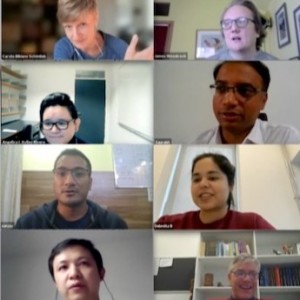
Some of the members of the INTEGRAL team who spoke to us over zoom. From top left: Carola-Bibiane Schönlieb, James Woodcock, Angelica Aviles-Rivero, Saurabh Pandey, Sanjay Bisht, Debmita Bandyopadhyay, Rihuan Ke, David Coomes.
In this podcast we talk to some of the members of the INTEGRAL team about the innovative machine learning approaches they are developing to understand remotely gathered images, and the significant impact these technologies can have on the world. Our thanks to Carola-Bibiane Schönlieb, James Woodcock, Angelica Aviles Rivero, Debmita Bandyopadhyay, Rihuan Ke and David Coomes, all from the University of Cambridge, and to Saurabh Pandey from KritiKal Solutions and Sanjay Bisht from IORA Ecological Solutions, both based in India.
You can read more about the INTEGRAL team's work in Seeing traffic through new eyes and about their new AI approaches in Maths in a minute: Semi-supervised machine learning. And you can find much more information about machine learning and image analysis on Plus.

Apr 19, 2022
Apr 19, 2022
28 min
How do you go about predicting something as complex as the Earth's climate? In this podcast — featuring climate modelling experts Emily Shuckburgh and Chris Budd — we explore what those climate models look like, the uncertainties involved in climate modelling, and also why the predictions need to be taken seriously despite those uncertainties.
We also look at the simplest climate model of them all— the energy balance model — and explain the famous butterfly effect in just one minute.
Emily Shuckburgh is a mathematician and climate scientist and Director of Cambridge Zero. The podcast features clips from Emily Shuckburgh's talk at the Cambridge Festival in March 2021, which was hosted by the Isaac Newton Institute in Cambridge. You can watch the full talk here.
Chris Budd OBE is a Professor of Applied Mathematics at the University of Bath, who works on climate models. You can read Budd's Plus article about climate modelling here.

Apr 12, 2022
Apr 12, 2022
18 min
In this week's podcast we reach into our archive for a favourite story we first heard back in 2010!
The quantum world is usually associated with the weirder end of physics, including strange phenomena like superposition or quantum entanglement, the "spooky action at a distance" as Einstein called it. But it turns out that quantum mechanical processes occur in living systems too. Some species of birds use quantum mechanics to navigate and studying how they do it might actually help us with building quantum computers.
Back in 2010 we spoke to the physicists Simon Benjamin and Erik Gauger at the conference Quantum Physics and the Nature of Reality at the University of Oxford to find out more.
For more information you can read our ridiculously short introduction to some basic quantum mechanics, and the accompanying article for this podcast.

Apr 5, 2022
Apr 5, 2022
24 min
Although people often talk about the links between maths and music, if you're neither a mathematician nor a musician these links might not be that obvious. In this podcast we get to explore the connection by going on a tour of the La La Lab exhibition with curator Daniel Ramos, talk to Jürgen Richter-Gebert, who created some of the exhibits, and asked Andreas Matt about the work of Imaginary, the group that produced this exhibition.
We were lucky enough to visit the La La Lab exhibition in person when it opened in September 2019 as part of the Heidelberg Laureate Forum. You might not be able to visit in person today, but you can still visit the exhibition virtually at Imaginary.
You can find out more about maths and music, Fourier analysis, Fibonacci, Manjul Bhargava and the Heidelberg Laureate Forum on Plus. And you can find detailed mathematical explanations of the La La Lab exhibitions in their excellent exhibition booklet.
(The image in this podcast is of the Tonnetz exhibit at the La La Lab Exhibition Image © Wanda Domínguez / Imaginary)

Mar 30, 2022
Mar 30, 2022
22 min
Like many early career researchers, Francesca Scarabel has moved around the world to take the first steps in her career: from her home in Italy, to Finland for her PhD, to Hungary and Canada for postdoctoral research. Now she works at the University of Manchester as part of the JUNIPER modelling consortium.
We spoke to Francesca about what it's like being part of the mathematical emergency response, the importance of local knowledge, and not being afraid to share your ideas.
You can read more about the work Francesca mentions in this podcast in Understanding waning immunity.
This podcast was produced as part of our collaboration with the JUNIPER, the Joint UNIversity Pandemic and Epidemic Response modelling consortium.

Mar 29, 2022
Mar 29, 2022
15 min
The Mathematical frontline podcast is about the mathematicians who are grappling with the unprecedented challenge of studying a live pandemic unfolding in front of their eyes.
In this podcast we are really pleased to talk to Ed Hill, a member of the modelling consortium from the University of Warwick, where he is also part of the Zeeman Institute for Systems Biology & Infectious Disease Epidemiology Research group (SBIDER). Ed tells us about his journey through the pandemic, his contribution to keeping work places and universities safe, and the importance of pacing yourself.
To read about some of the work Ed mentions in this podcast see the articles Pandemics and psychology and COVID-19 and universities: What do we know?
This podcast was produced as part of our collaborations with JUNIPER, the Joint UNIversity Pandemic and Epidemic Response modelling consortium, and the Isaac Newton Institute for Mathematical Sciences (INI).
Maths on the Move
Maths on the Move, the podcast from plus.maths.org, will bring you the latest news from the world of maths, plus interviews and discussions with leading mathematicians and scientists about the maths that is changing our lives. Hosted by Plus editors Rachel Thomas and Marianne Freiberger.
(Header image by FAVIO)
Maths on the Move is the podcast from Plus!
Are you curious about maths and the world? Then visit plus.maths.org to stay connected with mathematics, refresh your knowledge and keep up to date with current research! We welcome everyone into the world of mathematics, enabling curious non-experts to engage with maths concepts that arise in everyday life and raise awareness and appreciation of mathematics.
We publish articles, podcasts and videos on any aspect of mathematics, covering topics as diverse as art, medicine, cosmology and sport, and showing how recent news stories were often based on some underlying piece of maths that never made it to the newspapers. And all past content remains available online, which besides making for good browsing is, we hope, a useful resource for maths school students and teachers.
We want to encourage the next generation of mathematicians by providing diverse role models, helping to break down perceived barriers, and revealing the maths in many careers. Our focus on the mathematicians we work with, as well as on their research, brings mathematics to life, conveying the creative and dynamic nature of doing mathematics. We hope you enjoy discovering these mathematical stories!