Maths on the Move
Maths on the Move, is the podcast from plus.maths.org. We speak to researchers from the frontiers of mathematical science so you can connect with the maths that shapes and explains our world. Hosted by Plus editors Rachel Thomas and Marianne Freiberger.






Episodes

Nov 12, 2025
Nov 12, 2025
26 min
"I have learnt that even if you are not a master in mathematics and science you are still able to grasp the essence."
This is Céline Broeckaert talking, believe it or not, about the famously difficult theory of quantum mechanics. Céline knows what she's talking about. She's not a physicist, in fact she's a Romance languages scholar, author and playwright. Yet she's written a book about quantum mechanics together with her physicist husband Frank Verstraete, Leigh Trapnell Professor of Quantum Physics at the University of Cambridge. The book is called Why Nobody Understands Quantum Physics - and everyone needs to know something about it. And it's good timing: quantum mechanics celebrates its 100th birthday this year.
In this episode of Living Proof we talk to Céline and Frank about the book, what it was like writing it, and what their different backgrounds brought to the project.
We met Céline and Frank at the Isaac Newton Institute for Mathematical Sciences in Cambridge, where Frank is co-organising the research programme Quantum field theory with boundaries, impurities, and defects.
For a brief introduction to quantum mechanics see A ridiculously short introduction to some very basic quantum mechanics. To find out more about the overlap of maths and art, see here.
This content forms part of our collaboration with the Isaac Newton Institute for Mathematical Sciences (INI) – you can find all the content from the collaboration here.
The INI is an international research centre and our neighbour here on the University of Cambridge's maths campus. It attracts leading mathematical scientists from all over the world, and is open to all. Visit www.newton.ac.uk to find out more.

Nov 5, 2025
Nov 5, 2025
28 min
You are blue, and are surrounded by other blue people: swirling together in a dot, identical and indistinguishable. From somewhere above you hear the ticking of a clock, and suddenly find yourself and some of your fellows pulled upwards, sucked through a tube arcing high above...
Intrigued? That is a description of one of Jess Enright's adventures in her mathematical models. This is an exciting new approach that researchers are using to invite people into the worlds of their models, both to communicate their research to the people outside of academia, but also for the researchers themselves to reflect on what aspects of reality these models actually do, and don't, describe.
These adventures in model land build on the work of Erica Thompson in her book, Escape from Model Land: how mathematical models can lead us astray and what we can do about it. Any mathematical description of a process in the world around us is a mathematical model: whether it's describing the processes in our climate, the spread of a disease through a population or the movement of water across a landscape. They are incredibly useful and key to research in modern mathematics and science. But these mathematical models are, by necessity, simplifications of the real world.
Erica's book inspired geoscientist Chris Skinner to use principles of role-playing games to explore and communicate mathematical models. And this approach was a perfect fit with Jess' experience building board games to communicate her research - we event get to play some in this podcast at the huge UK Games Expo in Birmingham earlier this year!
Jess Enright, along with Emma Gort Tarrus, in action at the UK Games Expo in Birmingham earlier in 2025. (Photo: Rachel Thomas)
In this podcast we talk to Jess (a reader in the school of Computing Science at the University of Glasgow and member of the JUNIPER partnership of disease modellers from across the UK), Chris (an independent geoscientist and researcher and a visiting fellow at York St John University)and Erica (Associate Professor of Modelling for Decision Making at University College, London) about their explorations of these ideas.
You can find out more information about the ideas discussed in the podcast here:
Maths in a Minute: Mathematical model – a brief and an accessible introduction to mathematical models and where they are used.
Escape from Model Land: how mathematical models can lead us astray and what we can do about it – Erica's book
Adventures in Model Land– the framework, developed by Chris, Erica and Jess, together with Liz Lewis, Rolf Hut and Sam Illingworth, for exploring mathematical models using table-top role-play games
You can find some of the adventures in model land and other games that Jess took to the UK Games Expo in Birmingham
This podcast is part of our collaboration with JUNIPER, the Joint UNIversity Pandemic and Epidemic Response modelling consortium. JUNIPER comprises academics from the universities of Cambridge, Warwick, Bristol, Exeter, Oxford, Manchester, and Lancaster, who are using a range of mathematical and statistical techniques to address pressing questions about the control of COVID-19. You can see more content produced with JUNIPER here.

Oct 29, 2025
Oct 29, 2025
37 min
There's been a lot of talk recently about whether artificial intelligence is becoming just as good as maths as humans are. But quietly in the background there's been another development regarding the use of computers in maths. It involves proof assistants: computer programmes that can check whether a mathematical proof is correct; whether it can be derived from a set of basic axioms of mathematics using only the rules of logic.
In this episode of Living proof we meet Kevin Buzzard, an expert on proof assistants at University College London. Kevin explains what proof assistants are, how using them is like playing a computer game, and why they turn maths into a highly collaborative pursuit. He also tells us about his effort to get a proof assistant to check one of the most famous results in all of mathematics — Fermat's Last Theorem — and how proof assistants and AI may team up to provide a powerful tool.
We met Kevin in the summer when he was taking part in a research programme called Big Proof at the Isaac Newton Institute for Mathematical Sciences (INI) in Cambridge. This programme, which attracted some of the best minds in modern mathematics, followed on from a pioneering workshop on the same topic which took place at the INI in 2017.
To find out more about the topics mentioned in this podcast, see the following articles:
Proof assistants — This two part article, written by our brilliant summer intern Ben Watkins, is based on the interview with Kevin Buzzard and explores what proof assistants are.
Maths in a Minute: Coding with Lean — Here's a simple walk-through of how to use a proof assitant called Lean.
Pure maths in crisis? — In this article from 2019 Kevin Buzzard explains why he thinks that the standard of proof in research maths might not be as high as mathematicians would like to believe.
How to (im)prove mathematics — This article explores how the simple notion of counting ends in a revolutionary new way of doing maths using proof assistants. This article is based on a talk by Terence Tao at a 2024 workshop at the INI which celebrated the mathematics of Tim Gowers as well as his 60th birthday.
A very old problem turns 30! — This article explores Fermat's famous last theorem as well as the mathematics its proof has given rise to. It comes with a podcast featuring Andrew Wiles, who proved the result, and people who are now working on its legacy.
You can find more background reading in our collection on proof assistants.
This content forms part of our collaboration with the Isaac Newton Institute for Mathematical Sciences (INI) – you can find all the content from the collaboration here.
The INI is an international research centre and our neighbour here on the University of Cambridge's maths campus. It attracts leading mathematical scientists from all over the world, and is open to all. Visit www.newton.ac.uk to find out more.

Oct 22, 2025
Oct 22, 2025
24 min
In this episode of the Living Proof podcast we're delighted to meet Moustapha Fall. Moustapha is the Center President of the African Institute for Mathematical Sciences (AIMS) in Senegal and winner of a prestigious Ramanujan Prize for Young Mathematicians from Developing Countries. He also plays an important role on the international stage as Member-at-Large of the Executive Committee of the International Mathematical Union.
Moustapha talks to us about about the amazing institution that is AIMS, about his outreach activities and advice for budding mathematicians, and about the challenges that face mathematicians in sub-Saharan Africa.
You can find the IMU-ICIAM report on fraudulent publishing, which Moustapha mentions in the podcast, here. The same team of authors has also drawn up recommendations on how to fight fraudulent publishing.

Oct 15, 2025
Oct 15, 2025
23 min
Earlier this year the the anomalous mathematical patterns sci-art competition attracted some jaw-dropping entries. The competition was held in connection to the Stochastic systems for anomalous diffusion research programme which took place at the Isaac Newton Institute for Mathematical Sciences (INI) in Cambridge last year.
In this episode of Maths on the Move we talk to Codina Cotar, who co-organised the INI programme and helped put on the competition. Codina explains the maths which served as inspiration and discusses some of the winning entries. From coffee to quantum mechanics and from dance to diffusion, find out how mathematics, nature and art are inextricably linked.
Note that the in-person exhibition at the INI is now scheduled for March 2026.
The entries discusses in this podcast are shown below. To find out more about some of the mathematical topics mentioned in this podcast see:
The Sci-art competition - This article explores some of the mathematics behind the competition, including randomness, diffusion, and many particle systems.
The Fields Medals 2022: Maryna Viazovska - This article looks at the mathematics of sphere packings, which won a Fields Medal for the mathematician Maryna Viazovska.
Maths in a Minute: Fluid dynamics - A very bried introduction to the mathematics of liquids and gases.
A ridiculously short introduction to some very basic quantum mechanics - This article does what the title suggests.
A brief history of quantum field theory - A deeper look at the theory that arose from quantum mechanics.
Dye Diffusion in Water by Henrique Biasi. Find out more here.
A microcosm of milk by Christian Casaljay. Find out more here.
Work by Lilia Bakanova, which which won the category for textile, sculpture and other medium. Find out more here.

Oct 8, 2025
Oct 8, 2025
22 min
The mathematical area of topology is all about figuring out what truly defines a shape. Famously, topologists consider a coffee cup to be the same as a doughnut because one can be turned into the other without cutting or gluing — what defines and relates these two shapes for a topologist is that they have a single hole.
As you might imagine, if you have ever tried to drink coffee out of a doughnut, topology has traditionally been part of pure mathematics. Topological data analysis (TDA), however, opens up a world of applications by applying ideas from topology to vast data sets, helping us to understand their "shape" and draw out important features.
In this episode of Maths on the Move we talk to algebraic topologist Michael Hill about some of the fascinating uses of topological data analysis — from understanding breast cancer to making sure that voting is fair.
We talked to Michael after he gave a brilliant Rothschild lecture at the Isaac Newton Institute for Mathematical Sciences (INI) in Cambridge. He was at the INI to attend the research programme Equivariant homotopy theory in context.
To find out more about the topics mentioned in this podcast see:
Maths in a minute: Topology — a quick introduction to topology.
Understanding life with topology — a quick introduction to TDA and some of its uses.
Euromaths: Heather Harrington — An episode of our Maths on the move podcast giving and introduction to topological data analysis.
Watch Mike Hill's Rothschild lecture at the INI.
Topology based data analysis identifies a subgroup of breast cancers with a unique mutational profile and excellent survival - The paper by Nicolau, Levine and Carlesson, mentioned by Michael in the podcast, which uses TDA to identify a novel type of breast cancer.
The Data and Democracy Lab — mentioned by Mike in the podcast.
Also, here is an image illustrating the intuition behind topological data analysis. As discs drawn around a bunch of points arranged in a circle increase in radius, they eventually overlap to form a ring, and later overlap to form a single blob.
This podcast forms part of our collaboration with the Isaac Newton Institute for Mathematical Sciences (INI) – you can find all the content from the collaboration here.
The INI is an international research centre and our neighbour here on the University of Cambridge's maths campus. It attracts leading mathematical scientists from all over the world, and is open to all. Visit www.newton.ac.uk to find out more.

Oct 1, 2025
Oct 1, 2025
31 min
Welcome to the new season of the Maths on the Move podcast!
We start the season with theoretical physicist David Tong of the University of Cambridge looking at an important milestone in the history of physics: the 100th birthday of quantum mechanics which we celebrate this year. David tells us why a new theory was needed, which of the many strange aspects of quantum mechanics is, in his opinion, the most significant, and that Erwin Schrödinger had a tendency to be grumpy.
David also tells us how quantum mechanics links to quantum field theory, the language in which all of modern physics is formulated, and reveals some mysterious connections between very different areas of physics — such as the theory of black holes and fluid mechanics. Join us in a wavy dance from the very small to the very large!
For some background and further reading and viewing see:
David Tong's series of text books
A ridiculously short introduction to some very basic quantum mechanics
A brief history of quantum field theory
Heisenberg's uncertainty principle
Maths in a Minute: Black holes
What is general relativity? Plus asks David Tong
Sean Carroll's Mindscape podcast featuring David Tong

Jul 9, 2025
Jul 9, 2025
27 min
We may not notice it, but mathematics impacts our lives on a daily basis. Mathematical models inform policy decisions around the economy and public health. They are used to understand climate change and how to respond to it. They are vital in the design of public buildings and spaces. They are even used to try and prevent crime.
It seems reasonable, then, that the mathematical models should reflect people's interaction with each other and their environment, and that they should take account of people's perspectives and priorities. In this episode of Maths on the Move we talk to Liz Fearon, an epidemiologist at University College London, about a pioneering new project which aims to involve people in the production of mathematical models from the start, treating them as valued and equal members of the research team. Liz tells out about the motivation behind the project, how it works, and what she hopes to achieve.
To find out more about topics mentioned in this podcast see:
Co-production of mathematical models — the article accompanying this podcast
The website of the COMMET project
Disease modelling for beginners — our introduction to some basic concepts in infectious disease modelling
The inequalities of COVID-19 — our article exploring the role of the pandemic in amplifying social inequalities
Tracing mpox — our article about modelling the spread of mpox.
This podcast is part of our collaboration with JUNIPER, the Joint UNIversity Pandemic and Epidemic Response modelling consortium. JUNIPER comprises academics from the universities of Cambridge, Warwick, Bristol, Exeter, Oxford, Manchester, and Lancaster, who are using a range of mathematical and statistical techniques to address pressing questions about the control of COVID-19. You can see more content produced with JUNIPER here.

Jul 1, 2025
Jul 1, 2025
34 min
On May 30th 2024 seminar goers at Princeton University witnessed a thrilling moment. The mathematician Zhouli Xu of the University of California, LA, announced that, together with colleagues he had sorted out the 126th dimension. Not in general, but in regards to a problem that has taunted mathematicians since the 1960s. The problem involves strange shapes and is called the Kervaire invariant problem, after the mathematician Michel Kervaire.
In this episode of Maths on the Move Zhouli takes us on a trip into higher dimensions, giving us a gist of what this long-standing problem is all about and retracing some of the long, and sometimes arduous, journey towards a proof. We met Zhouli when he visited our neighbours at the Isaac Newton institute for Mathematical Sciences (INI) in Cambridge to take part in a research programme called Equivariant homotopy theory in Context.
To find out more abut the topics discussed in this podcast see:
Maths in a minute: Topology
The hypersphere in four dimensions
Telescope topology
This content forms part of our collaboration with the Isaac Newton Institute for Mathematical Sciences (INI) – you can find all the content from the collaboration here.
The INI is an international research centre and our neighbour here on the University of Cambridge's maths campus. It attracts leading mathematical scientists from all over the world, and is open to all. Visit www.newton.ac.uk to find out more.
Jun 25, 2025
Jun 25, 2025
23 min
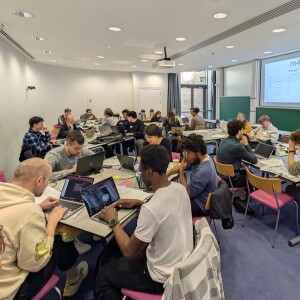
The capabilities of artificial intelligence may appear to be galloping ahead, but there are still many challenges that need to be solved. Last month we joined members of the Maths4DL research project for a hackathon — an intensive two-day brainstorming session designed to figure out how one might teach machine learning techniques for solving differential equations and how best to test those techniques.
In this episode of Maths on the Move, Maths4DL members Yolanne Lee from University College London, Georg Maierhofer from the University of Cambridge, and Chris Budd OBE from the University of Bath tell us all about the hackathon, the science behind it, and what it was like to participate in those ambitious but exciting 48 hours.
For a brief introduction to machine learning see Maths in a minute: Machine learning and neural networks and for a brief introduction to differential equations see Maths in a minute: Differential equations. You might also like:
Our podcast featuring Yolanne Lee talking about her work as a Maths4DL researcher,
Our podcast featuring Georg Maierhofer talking about physics informed neural networks, as well as the accompanying article,
Our article AI and GoPro physics featuring the work of Nathan Kutz who is mentioned in this podcast.
This content is part of our collaboration with the Mathematics for Deep Learning (Maths4DL) research programme, which brings together researchers from the universities of Bath and Cambridge, and University College London. Maths4DL aims to combine theory, modelling, data and computation to unlock the next generation of deep learning. You can see more content produced with Maths4DL here.
Maths on the Move
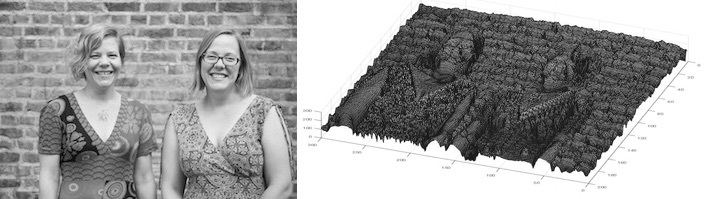
Maths on the Move, the podcast from plus.maths.org, will bring you the latest news from the world of maths, plus interviews and discussions with leading mathematicians and scientists about the maths that is changing our lives. Hosted by Plus editors Rachel Thomas and Marianne Freiberger.
(Header image by FAVIO)
Maths on the Move is the podcast from Plus!
Are you curious about maths and the world? Then visit plus.maths.org to stay connected with mathematics, refresh your knowledge and keep up to date with current research! We welcome everyone into the world of mathematics, enabling curious non-experts to engage with maths concepts that arise in everyday life and raise awareness and appreciation of mathematics.
We publish articles, podcasts and videos on any aspect of mathematics, covering topics as diverse as art, medicine, cosmology and sport, and showing how recent news stories were often based on some underlying piece of maths that never made it to the newspapers. And all past content remains available online, which besides making for good browsing is, we hope, a useful resource for maths school students and teachers.
We want to encourage the next generation of mathematicians by providing diverse role models, helping to break down perceived barriers, and revealing the maths in many careers. Our focus on the mathematicians we work with, as well as on their research, brings mathematics to life, conveying the creative and dynamic nature of doing mathematics. We hope you enjoy discovering these mathematical stories!