Maths on the Move
Maths on the Move, is the podcast from plus.maths.org. We speak to researchers from the frontiers of mathematical science so you can connect with the maths that shapes and explains our world. Hosted by Plus editors Rachel Thomas and Marianne Freiberger.






Episodes

Dec 6, 2022
Dec 6, 2022
21 min
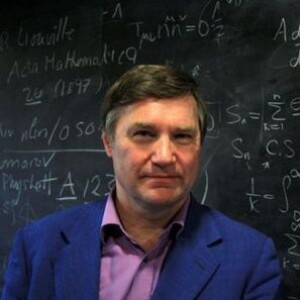
Will climate change leave the region you live in hotter and drier, or wetter and stormier? It's a question of utmost importance in many areas of the world, yet it's one that climate scientists can't answer. This is why world-leading climate scientist Tim Palmer is calling for a high-performance supercomputing centre dedicated entirely to climate change.
Tim Palmer.
We were lucky enough to meet Palmer at a recent event organised by the Newton Gateway to Mathematics In Cambridge. In this podcast we talk to Palmer about this call for a "CERN for climate change" and why climate forecasting requires so much computing power in the first place. Palmer also tells us about a technique for dealing with uncertainty called ensemble forecasting, and what his work has taught him about uncertainty more generally, as it crops up in many areas of life and nature.
Tim Palmer's new book on the science of uncertainty, The primacy of doubt, is published by Oxford University Press. To learn more about climate models see this article. To learn about weather forecasting see this article, and to read about uncertainty more general click here.
This podcast was produced as part of our collaboration with the Isaac Newton Institute for Mathematical Sciences (INI) – you can find all the content from our collaboration here. The INI is an international research centre and our neighbour here on the University of Cambridge's maths campus. It attracts leading mathematical scientists from all over the world, and is open to all. Visit www.newton.ac.uk to find out more.
Nov 29, 2022
Nov 29, 2022
23 min
There are some numbers you can rely on. The speed of light, c, is 299,792,458 ms-1. The gravitational constant, G, is 6.674 x 10⁻¹¹m3kg-1s-2. These are examples of what are often called the constants of nature – fundamental physical quantities that seem to be the same everywhere, and unchanging over time.
Or are they? Today would have been our wonderful boss, John D. Barrow's, 70th birthday. And to celebrate him and his work we look at the answer to this question in today's podcast.
John D. Barrow (Image credit: Tom Powell)
Over time, since these constants were discovered, people had hoped to find a theory, a great theory of everything, that would explain why these particular values had arisen. However, as John explains in this podcast, developments in recent decades, in areas such as string theory, have shown that these constants could take any value. And this provided the motivation for studying whether such constants might be changing in value.
John, together with the astronomer John Webb, initiated an observational programme looking at the light produced by quasars in the distant Universe. They developed new techniques to analyse the light to test if certain constants had the same value near a quasar as they did in laboratories here on Earth.
You can find out more about this aspect of John’s work in this podcast, and read more in his accompanying article: Are the constants of nature really constant? And you can find out more about some of John's other work and interests in his many Plus articles.
This interview was recorded in 2009 as part of our celebration of the International Year of Astronomy 2009, where we tried to answer the questions everyone wanted to ask about the Universe

Nov 23, 2022
Nov 23, 2022
15 min
Amid much controversy, the 2022 World Cup has begun and the action has now moved onto the football pitches inside the many newly built stadiums in Qatar. But how are these stadiums turned from architectural sketches into real buildings?
For this week's episode we delve back far into our archive to hear from Paul Shepherd from the University of Bath, an expert in building football stadiums such as the famous Emirates stadium in London. In this interview, first recorded back in 2007, he tells us about what kind of things are important in building a stadium, how maths is an integral part of the design process, and why his work required him to listen to Belgian techno.
The Emirates Stadium, home of the Arsenal football club. (Photo Arne Müseler – CC BY-SA 3.0 DE)
You can hear more about the maths behind famous sporting buildings in our recent podcast How the velodrome found its form. And you can find out much more about the maths behind football and sports, and behind engineering and architecture here on Plus.
Nov 15, 2022
Nov 15, 2022
20 min
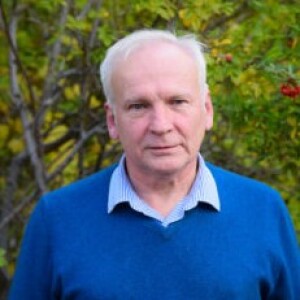
Yuriy Semenov was forced to leave Ukraine, and his work at the Institute of Hydromechanics at the National Academy of Sciences, due to the Russian invasion of February 2022. He found sanctuary in Britain at the University of East Anglia. In part this was thanks to the Solidarity for mathematicians programme ran by the Isaac Newton Institute for Mathematical Sciences (INI).
In this podcast Yuriy speaks to the INI's Dan Aspel and shares his experience of the Russian invasion of Ukraine, and why the work of a mathematicians is always possible.
We are very pleased to host this episode of the Living Proof podcast as part of our collaboration with the wonderful INI.

Nov 8, 2022
Nov 8, 2022
24 min
Professor Nataliya Vaisfel'd was until recently a mathematician at Odesa I. I. Mechnykov National University. Forced to flee Ukraine after the Russian invasion of her home country in February of this year, Nataliya has since travelled across Europe with her wheelchair-bound mother and their dogs, eventually finding sanctuary in Britain. In part this was thanks to the Solidarity for mathematicians programme ran by the Isaac Newton Institute for Mathematical Sciences. She is now a Senior Lecturer at King’s College London.
In this podcast Nataliya tells her story in conversation with the INI's Dan Aspel.
We are very pleased to host this episode of the Living Proof podcast as part of our collaboration with the wonderful INI.
This podcast was produced as part of our collaboration with the Isaac Newton Institute for Mathematical Sciences (INI) – you can find all the content from our collaboration here. The INI is an international research centre and our neighbour here on the University of Cambridge's maths campus. It attracts leading mathematical scientists from all over the world, and is open to all. Visit www.newton.ac.uk to find out more.
Oct 11, 2022
Oct 11, 2022
13 min
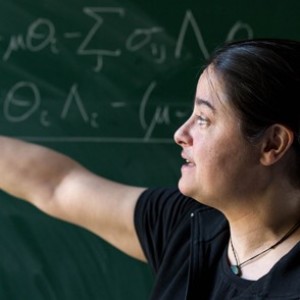
Over the summer we were lucky enough to meet some young female mathematicians who were just finishing up their summer research projects with the Philippa Fawcett Internship Programme and the Cambridge Mathematics Placements programme.
On our way to the writing workshops we were running with these women, we walked past six inspiring portraits of female mathematicians from Cambridge. These form part of the Women of Mathematics photo exhibition, which celebrates female mathematicians from institutions throughout Europe. It's been a great pleasure revisiting our our 2017 Women of Mathematics interviews with these mathematicians about their work and their mathematical lives in this special series of podcasts.
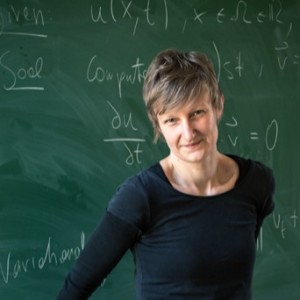
Today's podcast is the final one of this series, and we are very pleased to revisit our interview with Carola-Bibiane Schönlieb, now professor of applied mathematics and a very good friend of us here at plus.maths.org. Carola works on the interface between machine learning and the mathematics of image analysis.
You can read more about some of Carola's recent work, including how artificial intelligence can support medical doctors in their work, and the INTEGRAL project, a collaboration with Indian researchers on how machine learning can make sense of the vast amounts of remote sensing data that is available to help conserve forests and improve life in cities.
To find a transcript and video of this interview, meet the other female mathematicians, and find out more about the exhibition, see here.
Sep 20, 2022
Sep 20, 2022
9 min
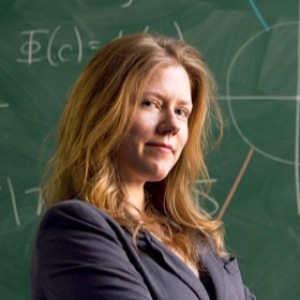
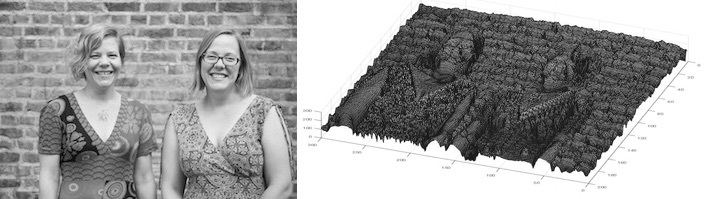
In this podcast we are very happy to revisit our 2017 interview with Holly Krieger, one of the six Cambridge mathematicians whose portrait is included in the Women of Mathematics photo exhibition. Krieger works in dynamical systems theory, particularly on chaotic systems. In this interview she told us about the joys of learning and conversations with colleagues.
Holly Krieger (Photograph by Henry Kenyon)
You can find more about Krieger's prize winning work in Dynamic numbers and you see her talk about complex numbers and dynamical systems in our collection Complex numbers: Why do we love them?
To find a transcript and video of this interview, meet the other female mathematicians, and find out more about the exhibition, see here.
Sep 14, 2022
Sep 14, 2022
9 min
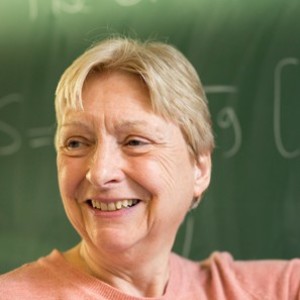
In this podcast we are very happy to revist our 2017 interview with Julia Gog - Professor of Mathematical Biology and a very good friend of us here at plus.maths.org. Over the last two years we've been working closely with Gog and her colleagues at the JUNIPER modelling consortium, communicating their work on the mathematical front-line of the COVID-19 pandemic.
In this interview, first recorded to celebrate the addition of six portraits of Cambridge mathematicians to the Women of Mathematics photo exhibition, Gog told us about the buzz of mathematical research, and how maths can help you do good in the world.
To find a transcript and video of this interview, meet the other female mathematicians, and find out more about the exhibition, see here. And you can read more about the work of Gog and her JUNIPER colleagues here.
Sep 6, 2022
Sep 6, 2022
16 min
In this podcast we revisit our 2017 interview with Anne-Christine Davis, Professor of Theoretical Physics. Anne was the first female professor in the Maths faculty at the University of Cambridge. In this interview, first recorded to celebrate the addition of six portraits of Cambridge mathematicians to the Women of Mathematics photo exhibition, Davis told us that over her long career she had seen attitudes towards women change for the better. But as you'll hear she had to put up with quite a lot at the start!
To find a transcript and video of this interview, meet the other female mathematicians, and find out more about the exhibition, see here. And you can read more about Davis' recent prize-winning research in our article On the road to dark energy (with chameleons).
Aug 31, 2022
Aug 31, 2022
10 min
Last week we started a special series of podcasts revisiting the Women of Mathematics photo exhibition, which celebrates female mathematicians from institutions throughout Europe. When the University of Cambridge hosted the exhibition in 2017, we had the opportunity to interview the six Cambridge mathematicians who's portraits appear in the exhibition about their work and their mathematical lives.
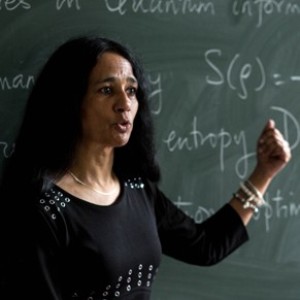
In this podcast we revisit our 2017 interview with Nilanjana Datta - now a professor in quantum information theory., who told us why she loves maths and also about some of the challenges she has faced as a female mathematician.
You can see all the Cambridge portraits and find out more about the work and mathematical lives of these women here. And stay tuned to this podcast for the rest of the interviews with these brilliant women of mathematics over the coming weeks.
The music in this podcast comes from the band eusa. The track is called Plankton.
Maths on the Move
Maths on the Move, the podcast from plus.maths.org, will bring you the latest news from the world of maths, plus interviews and discussions with leading mathematicians and scientists about the maths that is changing our lives. Hosted by Plus editors Rachel Thomas and Marianne Freiberger.
(Header image by FAVIO)
Maths on the Move is the podcast from Plus!
Are you curious about maths and the world? Then visit plus.maths.org to stay connected with mathematics, refresh your knowledge and keep up to date with current research! We welcome everyone into the world of mathematics, enabling curious non-experts to engage with maths concepts that arise in everyday life and raise awareness and appreciation of mathematics.
We publish articles, podcasts and videos on any aspect of mathematics, covering topics as diverse as art, medicine, cosmology and sport, and showing how recent news stories were often based on some underlying piece of maths that never made it to the newspapers. And all past content remains available online, which besides making for good browsing is, we hope, a useful resource for maths school students and teachers.
We want to encourage the next generation of mathematicians by providing diverse role models, helping to break down perceived barriers, and revealing the maths in many careers. Our focus on the mathematicians we work with, as well as on their research, brings mathematics to life, conveying the creative and dynamic nature of doing mathematics. We hope you enjoy discovering these mathematical stories!